Harvard Researchers Found That After 40, Your Body Loses 50% of This One Molecule
The same molecule responsible for your energy, focus, and how fast your cells age — and most people have never heard of it

By age 50, you have half the cellular energy you had at 25. Not because you're sick. Not because you're doing anything wrong. Because your body stopped making enough of one molecule — and nobody told you.
Every cell in your body runs on it. Your brain uses it to think. Your muscles use it to recover. Your DNA uses it to repair itself overnight. Without enough of it, everything slows down. Everything dims. Everything gets harder.
Scientists call it NAD+. You've probably never heard of it. Your doctor has almost certainly never mentioned it. That's the problem.

NAD+ levels drop 50% between age 20 and 50.1 By 60, some women are running at less than 30% of their peak.2 And unlike hormones — which doctors test for routinely — NAD+ deficiency is virtually never screened for, never discussed, and almost universally dismissed.

“This is just aging. It’s normal.”
“Learn to live with it.”
What 9 out of 10 women are toldIt isn't normal. And you don't have to live with it.
The 5 symptoms you've been writing off? They have a name. They have a cause. And for the first time, they have a solution that goes beyond another supplement on your nightstand.
You've tried everything a smart, health-conscious woman tries. Better sleep. Cleaner eating. A longer workout. A shorter workout. Magnesium. Ashwagandha. Probiotics. Hormone panels. Thyroid checks. You've sat in doctor's offices and been told your labs look “normal.” You've been handed pamphlets about stress management. You've been told — more than once — that this is just what getting older feels like.
You believed them. You shouldn't have.
Because here's what nobody told you: at 40, your body begins quietly dismantling its own power grid. Not your hormones. Not your thyroid. Not your stress levels. Something deeper. Something happening inside every single one of your 37 trillion cells — right now, as you read this.
The 5 symptoms you've accepted as normal? They're not aging. They're a deficiency. And there's a difference — because one has no solution, and the other does.
What Prescription NAD+ Actually Does

1. You're exhausted. Even after a full night's sleep.
You're not lazy. You're not depressed. You're not “overdoing it.”
Your mitochondria are underpowered.
NAD+ is the primary fuel source for mitochondrial function3 — the process that converts food into actual cellular energy. When NAD+ drops, your mitochondria can't complete the conversion. You eat. You sleep. You rest. And you still wake up tired.
Because the problem isn't how much rest you're getting. It's what's happening — or not happening — inside your cells while you sleep.
2. Your brain doesn't feel like yours anymore.
You lose words mid-sentence. You walk into rooms and forget why. You read the same paragraph three times. You used to be sharp. You still are — but it takes more effort now, and you feel it.
NAD+ is critical for neurotransmitter production and neuronal repair. When levels fall, the brain's ability to communicate with itself degrades. Slowly. Invisibly.
Your doctor ran labs. Everything came back normal. Because they never tested the one thing that was actually declining.
3. Your body is changing and you can't explain why.
Same diet. Same workout. Different body.
Weight collecting around your middle. Muscle harder to build, easier to lose. Recovery taking twice as long. You're doing everything right — and your body is ignoring you.
NAD+ activates a family of proteins called sirtuins — your body's master regulators of metabolism and fat storage.4 Without enough NAD+, sirtuins go quiet. Your metabolism shifts. Your body composition changes.
It's not willpower. It's biochemistry. And the biochemistry changed at 40.
4. Your skin is aging faster than the rest of you.
Not gradually. Suddenly. Like something switched.
NAD+ is a direct driver of collagen synthesis and DNA repair at the cellular level. When levels drop, skin cells can't repair daily damage fast enough. The turnover slows. The repair backlog builds.
What you see in the mirror isn't just sun damage or genetics.
It's your cells losing the fuel they need to rebuild overnight.
5. Your motivation, your joy, your drive — quietly disappeared.
This one is hardest to admit.
You don't feel like yourself. Not dramatically — no one would call it depression. But the things that used to excite you feel flat. The energy to start things isn't there. You push through because that's what you do. But something is missing and you can't name it.
NAD+ is directly involved in serotonin and dopamine regulation. As levels fall, the neurochemical architecture of mood and motivation quietly degrades.
You haven't lost your spark. Your cells have lost the fuel that creates it.
6. The supplement you're taking probably isn't doing what you think.
(capsule / powder)
(injection protocol)
There are dozens of NAD+ supplements on Amazon. Most are oral capsules or powders marketed as “anti-aging.” The problem isn't the molecule — it's the delivery.
Oral NAD+ is almost entirely destroyed by stomach acid and first-pass liver metabolism before it ever reaches your bloodstream. Published bioavailability data puts absorption below 8%.7 You're paying for a molecule your body never actually receives.
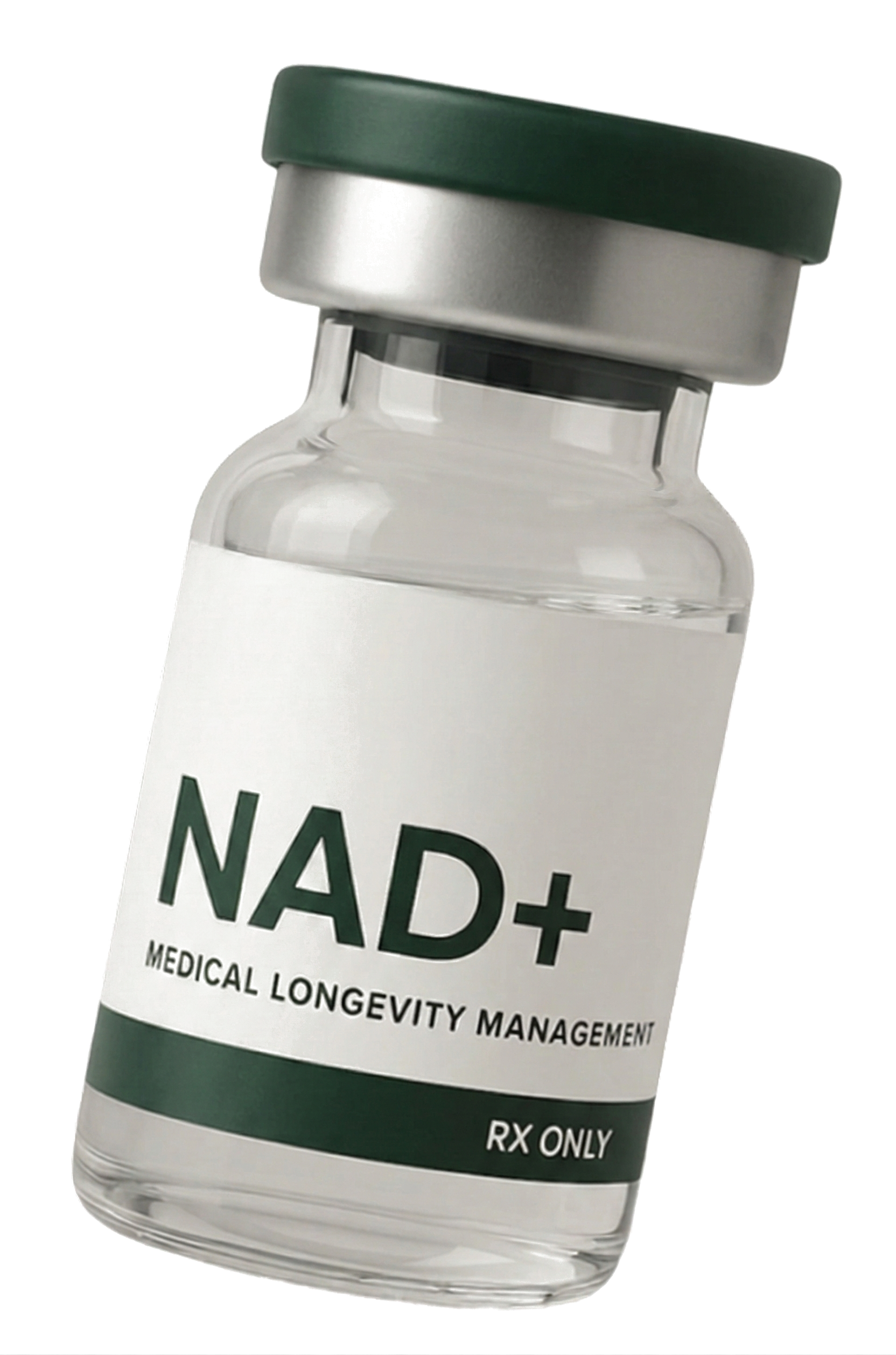
Prescription NAD+ bypasses the digestive system entirely. It reaches your cells intact — at therapeutic concentrations that oral supplements can't match.
It's not about taking more. It's about what actually arrives.

“The loss of NAD+ as we age, and the resulting decline in sirtuin activity, is thought to be a primary reason our bodies develop diseases when we get old but not when we are young.”

Every one of these symptoms has been documented. The research exists. The mechanism is understood. NAD+ decline after 40 is not controversial — it is consensus science.
But the average doctor's appointment is 18 minutes.6 There's no pharmaceutical incentive to screen for it. No insurance code for optimization. No protocol that says check her NAD+ levels before she hits 45.
So instead — you get told it's stress. It's hormones. It's age.
It's none of those things. It's a molecule. And molecules can be replaced.
127,000+ women over 45 have already checked their levels.